Curious people who hear how our family was formed want to know why we chose open adoption. For them and others we have not yet met, I think first we need to explain the general thoughts/definition of Open Adoption –
This is an excerpt from “What is Open Adoption?” by Brenda Romanchik. Ms. Romanchik is the birthmother of Matthew, born in 1984 and placed in a fully open adoption. She is one of the founders of Insight: Open Adoption Resources and Support and is the author of A Birthparent’s Book of Memories, Birthparent Grief, Your Rights and Responsibilities: A guide for expectant parents considering adoption, Finding Our Place: Birthparents in Open Adoptions and the upcoming Birthparenting. She lives in Royal Oak, Michigan with her husband and the two children she is parenting, Katarina and Daniel.)
What is Open Adoption?
“Ask five people what their definition of open adoption is and you are likely to get five answers. Some may think that allowing an expectant parent to choose the prospective adoptive parents from a profile of non-identifying information is an open adoption. Still others may say that those who met prior to placement and who exchange pictures and letters after the child is placed in the adoptive home are participating in an open adoption. This definition is, in fact, a variation of a semi-open adoption or openness in adoption.
So what is an open adoption? The primary difference between a truly open adoption and a semi-open adoption is that the adopted child has the potential of developing a one-on-one relationship with his or her birthfamily. It is not about the adoptive parents bestowing birthparents with the privilege of contact, nor is it about birthparents merely being available to provide information over the years. Direct contact, in the form of letters, phone calls and visits between the birthfamily and the adopted child, along with his adoptive family, is essential if they are to establish their own relationship. After all, how can we honestly call an adoption open if the child is not involved?
For many who are just beginning the adoption process, the concept of open adoption appears to be another complication they would rather not deal with. One prospective adoptive mom, weary from years of infertility, asked me at an adoption conference, “I am pursuing an international adoption because I don’t want to have to deal with my child’s birthfamily in any way. What can you say to me that would make me change my mind and pursue, instead, an open adoption?” My answer to her was simply this: “No matter where your child is adopted from, you will, as adoptive parents, need to ‘deal with’ your child’s birthfamily whether you know the birthfamily or not. This birthfamily is a part of who your child is. Open adoption allows you to know your child better by knowing his birthfamily.”
Expectant parents considering placing a child for adoption are often just as leery of the prospect of open adoption. Many are told, or feel, that ongoing contact will make it difficult to move on with their lives. Some are afraid that seeing their child will be too painful. Many worry that their involvement might confuse the child.
Making open adoption child-centered.
Many adoptive professionals encourage prospective birthparents and adoptive parents in the pre-placement process to choose the level of contact “they are most comfortable with having.” The philosophy of comfort does not take into consideration several very important factors, one being that open adoption should not be based on making the adults involved comfortable; rather it should be about providing for the needs of the child. Much of the open adoption experience is uncomfortable and awkward, especially in the beginning. While it is true that many children are only as comfortable as the adults around them, it is also true that many of us do things for our children that we are not totally comfortable with because it is good for them.
The other factor that the philosophy of comfort does not take into consideration is that adoption is a lifelong process. Many birthparents in the crisis of planning for an adoption look upon continuing contact as an option too painful to contemplate. Many adoptive parents, on the other hand, just want to be a family, without the added complication of visits with their child’s birthfamily. Most open adoption agreements are based on these feelings that occur around the time of placement. These agreements do not allow contact to ebb and flow according to the needs of all involved, most importantly the child. As time goes on, many birthparents, adoptive parents, and the adopted child find they want more contact, but feel they are not able to ask for more because of the original agreement. In cases such as these open adoption becomes a contract instead of a covenant.
According to Webster’s Revised Unabridged Dictionary, covenant is defined in part as being one of the strongest and most solemn forms of contract. It is also described as being sacred. For open adoption to work best, birthparents and adoptive parents need to see their involvement with each other as a sacred commitment, or a covenant they make to each other for the sake of the child.
Patricia Martinez Dorner, author of Children of Open Adoption and Talking to Your Child about Adoption, encourages us to see open adoption as just another form of blended family. In adopting, adoptive parents are welcoming the member of one family into their own. This “blending” of families is not without its share of uncomfortable moments, but the beauty of birthparents and adoptive parents accepting each other as family is twofold:
One, birthparents and adoptive parents really get to know each other. It allows them to see who the others are outside of their adoption experience. Birthparents can be seen as more than someone who found themselves in a difficult situation and adoptive parents can be seen as more than an infertile couple. Being able to know each other as complete human beings allows for greater acceptance. The adopted child is also able to know his birthparents as they are, rather than creating a fantasy birthparent. Instead of spending countless hours conjuring up an image of a person they do not know, they can use that energy for other things.
Two, it gives the child a sense of wholeness. There will no doubt be times when birthparents and adoptive parents take up the responsibility of maintaining the connection with each other. An infant, a toddler or a child cannot carry the burden of maintaining the connection between his two families. An adopted child whose birthfamily and adoptive family come together in a familial way, will grow up with greater certainty. There is a saying that the greatest gift parents can give their children is to love one another. I think it is inclusive of all parents, not just married couples.
So, what does a family blended by open adoption best compare to? In their book, The Open Adoption Experience, Sharon Kaplan-Roszia and Lois Melina state: “In practice, the relationship in open adoption is…comparable to that between in-laws.”
In marriage, a spouse accepts his or her in-laws because he or she realizes that they are an important part of who his or her spouse is. In open adoption, the adoptive family and birthfamily make a commitment to stay in contact because they also realize that the birthfamily is an important part of who the child is. As with in-laws, relationships vary. Some open adoption relationships develop into friendships while others are more distantly involved. All, however, recognize that they are family to one another, and important in the life of the child.”
***
So why did we choose open adoption? I chose this explanation as I felt it most reflected our family and beliefs … we are a family made through open adoption … My husband and I are the parents of two girls who are now age 6 and 4. We have very open adoptions with each of their birth families. But you see when we first started this journey to parenthood through adoption we were scared by our early readings on what open adoption was/is. You see living as a family in open adoption is not for the faint of heart …
Why you ask? Well it’s a human relationship for one and these need work and love to develop and prosper, if you don’t like the person you are in a relationship with how will you continue in your relationship? Two any relationships have their ups and downs, but being a family means you work through the downs to walk through the ups together … you see when you enter into an open adoption relationship you become family! So for those who may be faint of heart or for others considering this as a family-building option you need to learn what it is and not let your fear overtake your emotions … open adoption is not just about us, it is about our children, our girls and all of their family!
The first books we read did scare us as we didn’t have any connection to any families at that time raising children in an open adoption so we were scared of the unknown. We found an education support group for adoption through our local chapter of Resolve. We attended an information night and met many other couples just like us … hmmm we were not alone (after feeling very alone on our trying to bear a child journey) that was a good start! We then immediately signed up for the 8-week education group to gain as much information and understanding of what may lie ahead for us if we were to take this path to parenthood. Again we were not alone, our group was made up of 6 couples just like us trying to figure out if this was the right path to have a family and quite frankly what it was like. The 8 weeks were filled with lots of information and meeting families who were now parents of children who came to them through adoption. We met birth parents who were part of their child’s family. We met adult adoptees who did not have contact or a connection to their birth family and we could feel their losses. We met older children whose family always included their birth family. We saw it right there in front of us, we saw how regular/normal it was for them we saw it didn’t have to be scary or confusing … we saw that this was a way we may be able to have a family!
It was through our adoption facilitator that we continued to gain more information and meet many families made through open adoption. We found a community of people (again just like us). It was with the wisdom and guidance of our facilitator and the community of these other families we knew this was how we wanted to have a family and what we would want for our future children. We wanted to be sure that when we met or talked with an expectant woman that she too wanted the same; and that being an ongoing in-person familial relationship for all of us. We wanted to be sure that the adults making these initial decisions were all working from the same page, that we all wanted to be a family together for our child/children together.
We saw that in choosing open adoption as a way to have a family, our children would always have a connection and know and be loved by ALL of their families! We wanted them to know who they look and act like, we wanted for them to know siblings and grandparents, aunts and uncles. We wanted to have this family to be there for them to help heal their losses.
So here we are today we are a FAMILY together involved in each other’s lives, we see each other, we love each other, our girls know their families ALL of them from their birth parents through to great grandparents, grandparents, aunts, uncles, cousins and siblings. We realize everyday how blessed we are by the transformation of our family from just the two of us to our daughters and their families together as one family! We are blended together seamlessly as one and for our girls they know no different they just know that we are all family and that we all love and care for them and each other and that’s how we roll as a family!
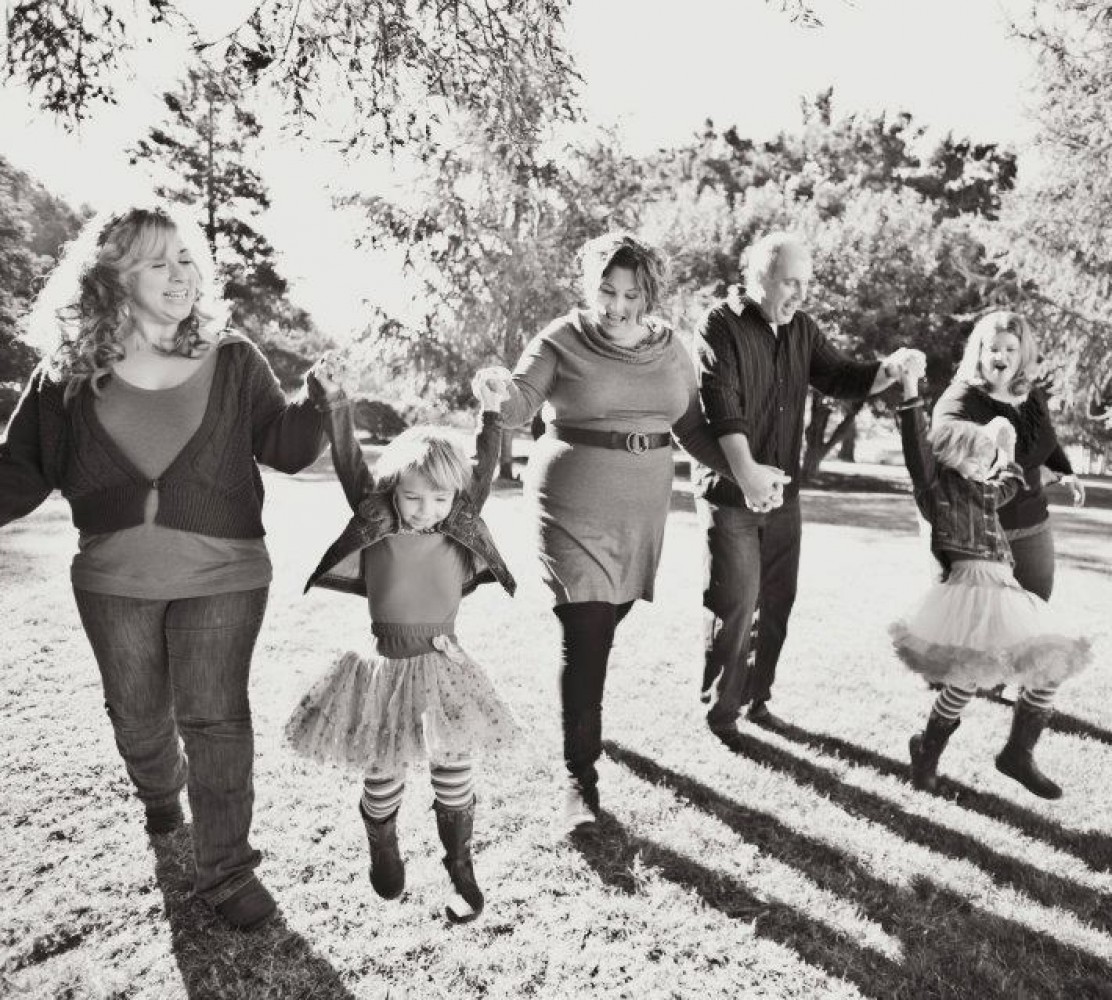

 What makes a Real family?